Quartz vs Granite Countertop Cost
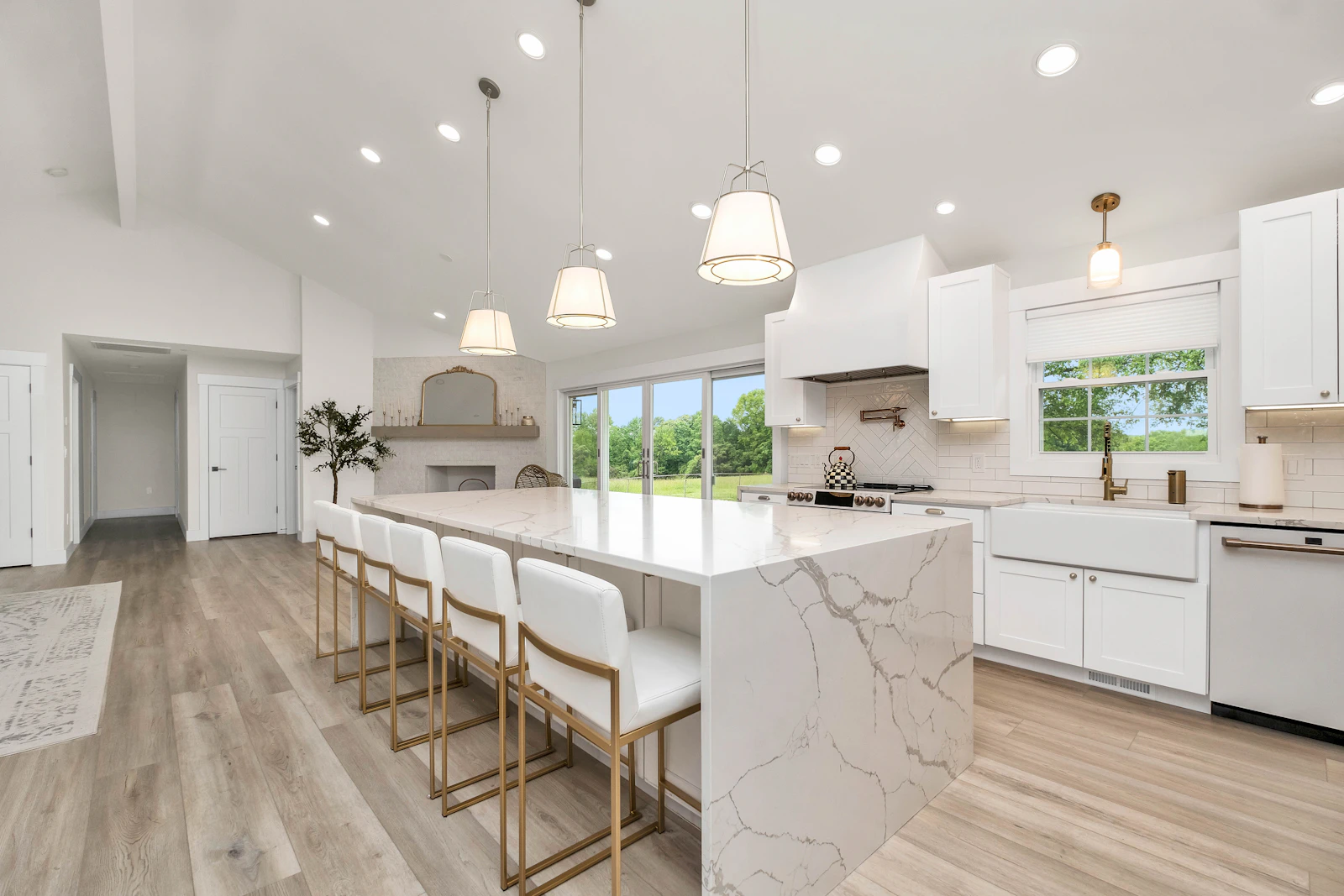
Quartz countertops typically cost $50–$120 per square foot installed, and granite countertops typically cost $40–$100 per square foot installed, at national-average prices in 2026. For a typical kitchen with about 40 square feet of countertop, that works out to roughly $2,000–$4,800 for quartz and $1,600–$4,000 for granite, including the slab, fabrication, a standard edge, and installation. Granite is usually the cheaper of the two by about $10–$20 per square foot, but the gap closes fast once you compare similar quality levels, and quartz costs nothing to seal or maintain.
This guide compares the two stones on installed cost, durability, upkeep, and resale, then covers the extras that quotes most often leave out. It is written for a homeowner replacing countertops in an existing kitchen. If the counters are part of a full remodel, the kitchen remodel cost calculator puts the countertop price in the context of the whole job: a mid-range remodel of a 150 sq ft kitchen typically runs $31,000–$42,500.
Cost at a glance
| Quartz | Granite | |
|---|---|---|
| Installed cost per sq ft | $50–$120 | $40–$100 |
| Entry level (common colors) | $50–$65 | $40–$55 |
| Mid-range (popular patterns) | $65–$90 | $55–$75 |
| Premium (designer or exotic stone) | $90–$120+ | $75–$100+ |
| Typical 40 sq ft kitchen | $2,000–$4,800 | $1,600–$4,000 |
| Sealing | Never | About once a year |
| Heat resistance | Good, but not for hot pans | Very good |
| Typical lifespan with normal care | 20–30+ years | 25+ years |
Ranges are national averages for installed cost, including the slab, cutting and polishing, a standard eased edge, delivery, and installation on finished cabinets. Labor rates in high-cost metros can run 20–40% above these figures; see how we calculate costs. Exotic granite slabs can run past $100 per square foot and cost more than mid-range quartz, which is the one place the usual price order flips.
What quartz and granite actually are
Granite is a natural stone, cut straight from a quarry, polished, and installed as a slab. Every slab is one of a kind: the pattern, veining, and color vary from piece to piece, and even two slabs from the same quarry can look different. That is the main reason people pick granite, and also the main reason to see the actual slab before you buy. A sample chip shows a square inch of a stone that may have a very different pattern a few feet away.
Quartz countertops are engineered stone: roughly 90–95% ground quartz mixed with resin and pigment, then pressed into slabs. The pattern is consistent from slab to slab, which makes it easy to match a sample to the finished counter and to get a uniform look across a large island. The resin is also what makes quartz nonporous, so it never needs sealing. The trade-off is heat: the resin can scorch or crack under sustained high heat, so a hot pan straight from the stove belongs on a trivet, not on the counter.
Neither material is a thin veneer. Both are usually installed at 3 cm (about 1 1/4 inches) thick. Thinner 2 cm slabs cost less per square foot but need a plywood support layer and look thinner at the edge, so compare 3 cm prices to 3 cm prices when you get quotes.
Durability and day-to-day use
For everyday cooking, both stones hold up well, but they fail in different ways.
Granite is the tougher of the two against heat. A hot pan or a baking sheet straight from the oven will not hurt a sealed granite counter, though a trivet is still good practice. It resists scratches from knives and pots reasonably well, but it can chip at a thin edge or around a sink cutout if something heavy drops on it. Because it is porous, an unsealed spot can stain from red wine, coffee, or oil left sitting overnight. Sealed granite resists those stains well.
Quartz resists stains and scratches at least as well as granite, and better in one respect: because it is nonporous, spills stay on the surface and wipe off, even if you miss them for a few hours. Its weak point is heat. A pan above about 300°F set directly on quartz can leave a scorch mark or, in rare cases, crack the slab. Quartz can also chip at edges, and a chip in a patterned quartz slab is harder to hide than a chip in busy granite.
Both materials are heavy and rigid, so the cabinets underneath need to be level and in good shape. If your cabinets are sagging or out of level, the fabricator will shim or the installer will flag it, and that is work to price before the slab arrives, not after.
Maintenance: sealing and upkeep
This is the biggest practical difference between the two, and the one that matters most after the first year.
Granite needs to be sealed, usually about once a year. The test is simple: sprinkle water on the counter. If it beads up, the seal is fine. If it soaks in and darkens the stone, it is time to reseal. A bottle of penetrating sealer costs about $20–$40, covers a typical kitchen, and takes under an hour to apply yourself. Hiring it out typically runs $150–$300. Skipping it does not ruin the stone, but it leaves it open to stains.
Quartz needs no sealing at all, ever. Daily cleaning is mild soap and water for both materials. Avoid harsh cleaners, oven cleaner, and abrasive pads on either stone, and avoid bleach-based cleaners on quartz, which can dull the resin over time.
Over a 10-year span, granite sealing adds roughly $200–$400 in sealer if you do it yourself, or $1,500–$3,000 if you hire it out every year. That is not enough to erase granite's price advantage, but it narrows it, and it is a chore quartz owners never think about.
Looks, seams, and resale
Granite looks like a natural stone because it is one, and buyers who want character tend to prefer it. The pattern is the selling point, so pick your slab in person and ask the fabricator to lay out the template so the best-looking section lands on the island or the most visible run.
Quartz looks cleaner and more uniform, which suits modern kitchens and makes it easier to match a backsplash or a paint color. Marble-look quartz is the closest thing to a marble counter without marble's upkeep, and it is the pattern most buyers ask for by name.
Both materials need seams on large counters. A standard slab covers about 60–70 square feet, so a big island or an L-shaped run will have at least one seam. Ask where the seam will fall and how it will be filled before you sign, and get it in writing. A seam placed across the middle of an island is far more visible than one tucked near a corner.
For resale, both are safe choices. Neither adds a fixed dollar amount to a home's value, and buyers rarely pay extra for one stone over the other. What matters is condition: a stained, chipped, or badly seamed counter hurts a sale, while either stone in good shape reads as a quality kitchen. If you plan to sell within a few years, pick the stone that looks best with your cabinets and skip the exotic slab that only you would love.
What quotes often leave out
The per-square-foot price is only part of the bill. Before you compare two quotes, check that each one covers:
- Old countertop removal and disposal. Typically $100–$400 for the tear-out and haul-away, and it is often a separate line. If the old tops are tile or concrete, removal costs more.
- Sink and cooktop cutouts. A standard undermount sink cutout is often included; extra cutouts, such as a second sink or a cooktop, typically run $75–$200 each.
- Upgraded edge profiles. A standard eased edge is included. Ogee, bullnose, and mitered edges typically add $10–$30 per linear foot.
- Plumbing disconnect and reconnect. The sink has to come out and go back in. A plumber typically charges $150–$400 for the disconnect and reconnect, and the fabricator's crew usually does not include it.
- Backsplash. A matching stone backsplash typically runs $10–$30 per square foot installed, and a tile backsplash is a separate job with its own price.
- Seams and slab selection. Ask how many seams there will be, whether you can approve the slab, and whether the price is for a specific slab or for a price group. A quote priced on a common granite can jump if the slab you pick is in a higher group.
- Templating and delivery. Laser templating, delivery, and installation should be itemized. If a quote looks far below the rest, one of these is usually missing.
Paste your quote into the Quote Checker to see what is missing before you sign. And if the counters are part of a larger remodel, run the numbers through the kitchen remodel cost calculator so a cheap countertop price does not hide an expensive project.
Which should you choose?
Choose granite if you want natural stone character, you cook with hot pans and want the most heat-tolerant surface, your budget is tight and you are happy with a common color, or you do not mind resealing once a year. Pick the slab in person.
Choose quartz if you want a consistent pattern you can match to a sample, you want zero sealing and the easiest stain resistance, your kitchen gets heavy daily use with kids or red wine, or you like the marble look without marble's upkeep. Use trivets for hot pans.
If you are torn, get quotes for both from the same fabricator on the same layout, with the same edge and the same cutouts. Seeing the two installed totals for your actual kitchen, with the same scope, makes the choice much clearer than any national average. A $10–$20 per square foot difference is $300–$600 on a typical kitchen, which is real money, but it is small next to the cost of living with the wrong stone for 20 years.
Frequently asked questions
Is quartz cheaper than granite?
Does granite need to be sealed every year?
Can you put a hot pan on quartz countertops?
Which countertop adds more resale value, quartz or granite?
Can a chipped quartz or granite countertop be repaired?
More cost guides
 Comparisons
Vinyl vs Wood Fence Cost
Vinyl costs roughly a third more than cedar up front but skips staining and repairs. Here is how the two compare over 20 years, and when wood is the smarter buy.
Read guide → Comparisons
Concrete vs Asphalt Driveway Cost
Asphalt usually wins on upfront price; concrete usually wins on lifespan and low upkeep. Here is how the two compare on your actual driveway size.
Read guide → Comparisons
Heat Pump vs Furnace Cost
One system doing both jobs versus two systems splitting them: installed cost, running cost, and cold-weather performance compared.
Read guide →